Thursday, April 25, 2013

Interview With Hsuan Tsung

Jacquelyn Zinchuk: What do you think of your original ideas as emperor?

Hsuan Tsung:  Honestly, I tried my hardest at bringing honor and respect to the dynasty that the previous rulers had taken care of before me.  I wanted to make the government strong so merely tried to strengthen the imposition of our laws.  The political and economical views of the Tang Dynasty were changing.  As you know, the Silk Road was widely used in the Tang Dynasty at times so many people were moving in and out of China. As a result, I strengthened the borders.  I emphasized the arts during my reign and focused on expansion.  I believe I carried out many of my ideas and most worked well.

Jacquelyn Zinchuk: Do you regret adding the new political elements that ended your reign?

Hsuan Tsung: I do regret them and I do believe I made a mistake.  I misjudged the strength and power I was handing to the officials and did not realize the depletion of mine in the process.  I handed them the power to enforce the laws, but had no idea how they were really using them.  All the same, I do not believe I put the Tang Dynasty in incapable hands.  The officials who enforced the laws were well qualified for their job and knew how to control the people of the Tang Dynasty.  I would not have picked them to implement my reforms if they were not to the highest standards.

Jacquelyn Zinchuk:  Why did you want to expand the Tang Dynasty?

Hsuan Tsung: I felt the need to expand the Tang Dynasty because I wanted to spread our culture. I love the arts and I wanted to share ours with the world. I supported many artists, musicians, and poets as well.  Also, conquering more land would bring more power and strength to the Tang Dynasty.  As a new emperor, I wanted to establish a reason for the people to revere me, and what better way than expanding their territory?  Although, I must admit I desired more for the glory of conquest and that is mainly why I had such an aggressive foreign policy.

Jacquelyn Zinchuk:  Why did you allow your wife the ability to control the Tang Dynasty's officials?

Hsuan Tsung:  I loved my wife dearly and was very blinded by her looks and charms.  She took advantage of my high authority as an emperor to support her family and friends.  I do admire her courage and kindness to do that without my permission to help out her loved ones, but I was very ashamed in the result.  I cannot really say why I let her ruin the stability I built for the Tang Dynasty, because the fact is I was a very weak man.  I was strong in my political stature and helped the Tang Dynasty prosper, but I was not strong enough.

Jacquelyn Zinchuk: Okay, last question.  What would you say your biggest weak point is?

Hsuan Tsung:   My biggest weak point is my ambition.  I wanted to strengthen the political power of the Tang Dynasty, but the way I did it, which deemed the best, ended up failing me.  I only thought of what was good for controlling the dynasty, but did not realize how easily it could be taken advantage of.  I also did this with expanding my dynasty.  I strengthened the border as we pushed forth to protect against vengeful enemies, but I gave the border generals too much power.  The commanders became too strong and independent and when a fight broke out between two of them, I could only flee the capital.  I was very ashamed I left my dynasty to live in turmoil for eight years. 

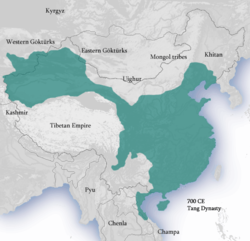
The Spread of the Tang Dynasty

http://upload.wikimedia.org/wikipedia/commons/thumb/1/1c/Tang_Dynasty_circa_700_CE.png/250px-Tang_Dynasty_circa_700_CE.png


Tang Dynasty: 618-907 AD
           The Tang Dynasty took control of almost all of China and Vietnam, impacting as far as Japan, Korea, and Central Asian countries, such as Afghanistan. The boundaries lay from the Tarim Basin in the west, to the Korean Peninsula in the east, Mongolia in the north, down to modern Vietnam.  The boundaries consist of a broad area that ascended from east to west.  The lowlands lay in the east, consisting of the Manchurian Plain and the North China Plain.  Rivers flowed west to east, emptying out into the Pacific Ocean.   Several important rivers were the Xi, Yangtze, Yellow, and the Wei Rivers.  Plateaus and mountains make up the west side of the Yang Dynasty.  Deserts were also located to the north and west of the dynasty.  The people of the Tang Dynasty made excellent use of the rivers, reopening the Silk Road to the world. Chinese traders began using the sea as another way to transport goods, which was called the Maritime Silk Road. During this prosperous period of trade, many foreign traders and merchants came to live in southern Chinese cities.  Most cities were located in the lowlands where farming was best, creating abundances of food to support a growing population.  The deserts and mountains that surrounded the western side of the Tang Dynasty kept out invaders and protected the dynasty for many years. 

 Information:
http://totallyhistory.com/tang-dynasty-geography

http://lilianaintegratedproject09.wikispaces.com/The+Tang+Dynasty%27s+Climate+and+Geographic+Factors

http://www.newworldencyclopedia.org/entry/Tang_Dynasty

Ideologies

Confucianism

     Confucianism was started by a Chinese philosopher by the name Confucius long before the Tang Dynasty.  The Tang Dynasty simply revived the ideas that were implemented among the Confucian guidelines.  Confucius wrote The Analects that provided guidelines of Education, Society, Politics, and Behavior.  He believed that a society should mirror a family in the way roles are carried out and that everyone should respect those above them, while those above must set a good example.  Confucius taught people to be compassionate and nice, avoiding extremes in behavior. According to his teachings, one must be free of greed and possessions.  Thus, it influenced those in the Tang Dynasty to live modestly. “Wealth and honor are what people desire, but one should not abide in them if it cannot be done in accordance with the Way" (The Analects as quoted by “Selections from the Confucian Analects”). Under Confucianism, those seeking positions of high authority were required to take a test because it was understood that those who were qualified, would be best.  Confucianism allowed the Tang Dynasty to have a very strong centralized government.  People were expected to submit to the emperor, while the emperor must act properly.  Government officials were chosen based on their education and performance on the civil service examinations, strengthening the government's control.  The moral codes embedded in The Analects also guided the people to act justly and for the emperor to be honorable and kind.  Confucianism was the basis of the Tang Dynasty's society and government, and since many officials were Confucian, the religion helped strengthen the dynasty's political power.  

Buddhism

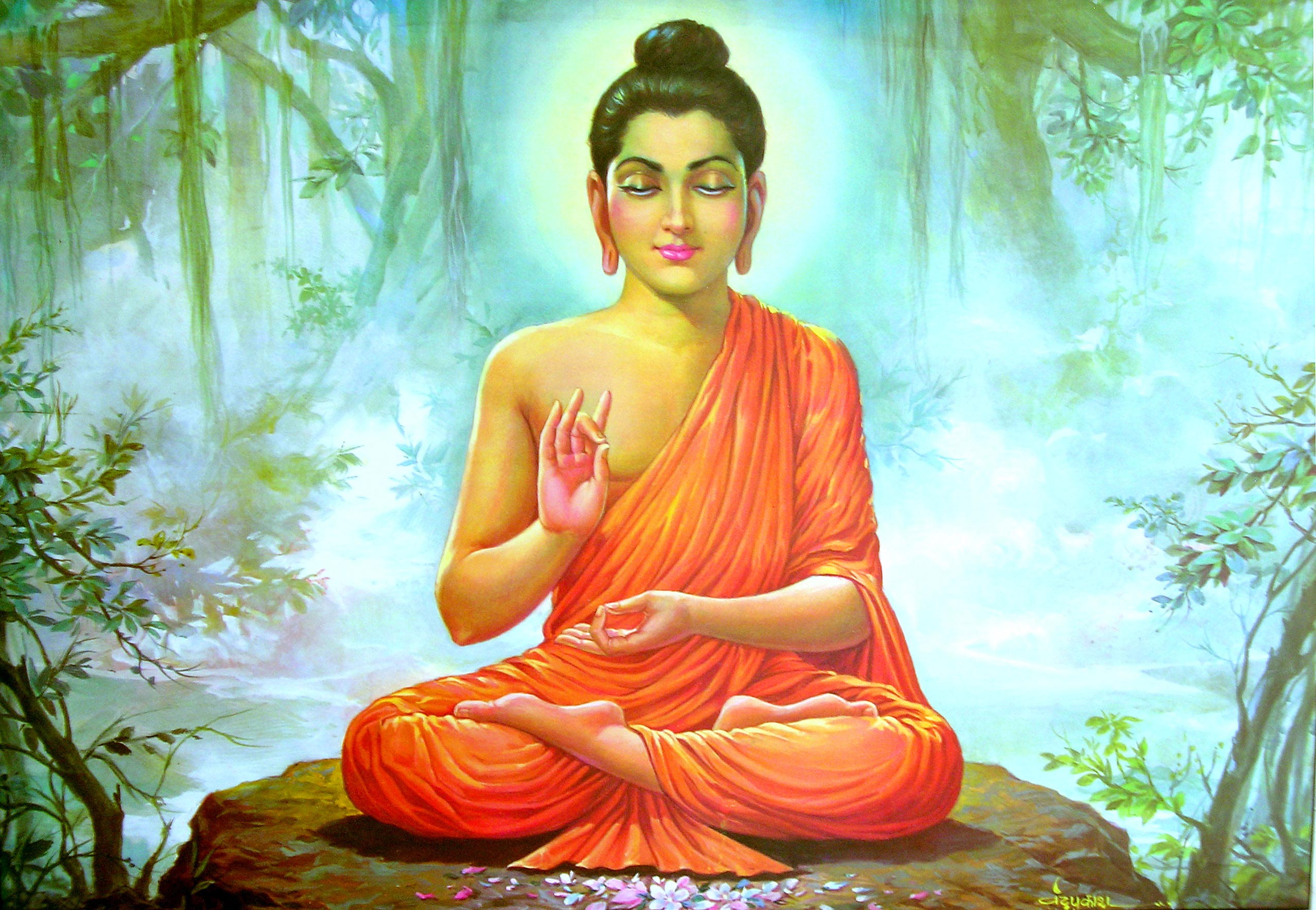
     Buddhism originated in India and traveled to China as early as the Han Dynasty through Persian, Central Asian, and Indian traders along the Silk Road.  It reflected the teachings of a man named Buddha who spent his life in prayer.  Buddhism had a different outlook on the afterlife than other religions.  It believed that the soul was not permanently attached to its human host, therefore, when a human dies, it is reborn into another being based on the way the human lived.  The goal of Buddhism is to achieve nirvana, or the state of enlightenment which is free of ignorance, greed and hate.  The Four Noble Truths of the religion were its main pillars.  They stated that life is suffering, which is caused by desire.  In order to free oneself from suffering, one must be free of desire and to get rid of desire, one must follow the eight-fold path.  This path consisted of eight rights, right views, right resolve, right speech, right action, right livelihood,  right mindfulness, right effort, and right concentration. After the Han Dynasty's ruin, China was in a period of political instability.  Buddhism promised a relief from that, viewed as a religion of salvation, and as a result, monks held high positions of authority.  When China was reunified through the Tang Dynasty, Buddhism peaked.  During Empress Wu's reign, which strengthened Buddhism for the purpose of weakening growing Daoists, Buddhism grew and spread with great success.  Nearing the end of the Tang Dynasty, Confucian authorities felt threatened by the growing religion and ordered the persecution of Buddhists. Certain emperors of the Tang Dynasty despised Buddhism and vocally opposed it.  This strengthened the cause of the persecution. "[Buddhism] wears out the strength 
of the people with constructions of earth
and wood, pilfers their wealth
for ornaments of gold and precious objects, causes men
 to abandon their lords and parents for the company of teachers, and severs man
and wife with
 its monastic decrees" (Emperor Wuzong as quoted by “Selection from Emperor Wuzong’s Edict on the Suppression of Buddhism”). As a result, tens of thousands of Buddhist temples were demolished and over 200,000 monks' and nuns' lives were slain.   Although peaking and declining within the years of 618-907 AD, Buddhism held a strong influence on its people.  As mentioned before, Buddhism provided salvation to those who had felt the burden and instability of the fall of the Han Dynasty.  It also promised a better life after death if the person had lived a selfless life.  Therefore, many people were influenced to act morally and for the good of others.  Many men left the fields to live a monastical life, and since the production of food relied on men, this angered many officials. Also, art prospered under Buddhism because it was a form of expression and many great poets, artists and sculptors arose from the Tang Dynasty.  

Opinion/Editorial

Was Emperor Hsuan Tsung a Bad Emperor?
By: Jacquelyn Zinchuk, Junior Writer

     Emperor Hsuan Tsung lived from 685-762 AD.  He is the seventh emperor of the Tang Dynasty and the great nephew of Empress Wu, the only female emperor in the Tang Dynasty. He helped his father restore the throne and 710 and becomes emperor himself in 713.  He is a vigorous and active ruler at first by continuing the efforts of preceding rulers, but his efforts ended in his downfall.  While emperor, he implements many different ideas to strengthen its political, economical, and military power.  Eventually, Hsuan Tsung falls in love with a woman and neglects his duties.  The woman takes advantage of him and appoints her family and friends in high positions of authority that eventually lead to an eight year rebellion.  Due to his lack of responsibility, Hsuan Tsung is one of the worst emperors ever to lead the Tang Dynasty.
     While Hsuan Tsung tries to continue the efforts of previous rulers, the new political changes he added to strengthen the dynasty ended in his downfall.  "To carry out his reforms, he used individuals and groups that could help implement his policies. In doing this... he introduced new political elements... that eventually usurped power and authority" (“T’ang Hsuan-Tsung”).  Hsuan Tsung, even though tries to make the dynasty prosperous, is not strong enough to control those below him.  A strong emperor is one who is able to have full control over those under them, while still maintaining their rights, happiness, and power.  Hsuan Tsung proves his irresponsibility by losing control of his people.  He also failed his dynasty by terminating his rule through his own actions, and possibly putting it in the danger of incompetent hands.  He neglects his duties because of his own selfish desire and puts the Tang Dynasty in great turmoil.  The woman he fell in love with appointed incapable people to government positions and the people she placed in those positions caused a rebellion.  "After this rebellion, the central government was never the same. The Tang could no longer control the generals along the border" (“The Tang Dynasty”).  Hsuan Tsung establishes his inability to rule his dynasty by not fulfilling his duties, especially since it is through his weakness for women.  Because of him, these eight years of fighting greatly hinders the Tang Dynasty.  It weakens the Tang Dynasty's government, which is the most important aspect of it.  Without its centralized government, a dynasty is unable to rule its people properly.  Also, Hsuan Tsung weakens the borders of the dynasty, leaving it vulnerable to be attacked and conquered by outside powers.  He is the worst emperor of the Tang Dynasty because his rule leaves the Tang Dynasty in shambles.  


News Story

BUDDHISM UNDER ATTACK
Written by: Jacquelyn Zinchuk, Junior Writer

       During the reign of the Tang Dynasty, 618-907 AD, Buddhism was carried to China continuously and spread using the Silk Road.  Empress Wu encouraged the growth of Buddhism to weaken her Taoist enemies. Instead of focusing on life itself, like most religions and ideologies, Buddhism taught that life was suffering and in order to achieve a better afterlife, one must act morally and just.  It offered support to people who were suffering, believing they could escape it in the afterlife.  Devoted followers were named monks and nuns and lived in monasteries.  They secluded themselves from others and lived a monastic life, arousing suspicion from Confucians.  Confucianism focused primarily on materialistic guidelines.  Society, behavior, family, education, and politics were important to them, not spirituality, thus created many gaps between the two groups. In order to be monastic, one's family name, hair, and earthly desires must be sacrificed.   In the Tang Dynasty, temples and shrines were an abundance.  Common people donated to them in order to receive earthly and spiritual rewards. 
      By the end of the Tang Dynasty, a persecution of Buddhism had been brought upon the prosperous empire.   Threatened by its growing influence, Confucian officials began to vocally oppose it.  They spread word that it was a threat to the common people and a burden to the Tang Dynasty.  In AD 842, Emperor Wuzong launched a persecution of foreign religions.  More than 4,600 monasteries and 40,000 temples and shrines were destroyed.  Nuns and monks were forced to withdraw from their monastic life and return to living under Confucianism, otherwise, they were slaughtered.  It has been stated that this oppression was for economical purposes.  The metal from the shrines and temples were melted down and used as silver coins.  When monks and nuns were returned to the common life, they were forced to pay the general tax base. The persecution was also because Buddhism was becoming too powerful.  Emperor Wuzong was a Taoist, and much like Empress Wu, used the differences in the two ideologies to support his cause, especially since Confucians did not fancy Buddhism either. The Taoist emperor was devotedly religious and believed a way to spread his beloved Taoism was to oppress Buddhism so it could not overshadow it.  

Persecution of Buddhism
http://www.crimesofwar.org/wp-content/uploads/2011/03/Persecution-on-Political-Racial-or-Religious-Grounds-300x225.jpg


Information